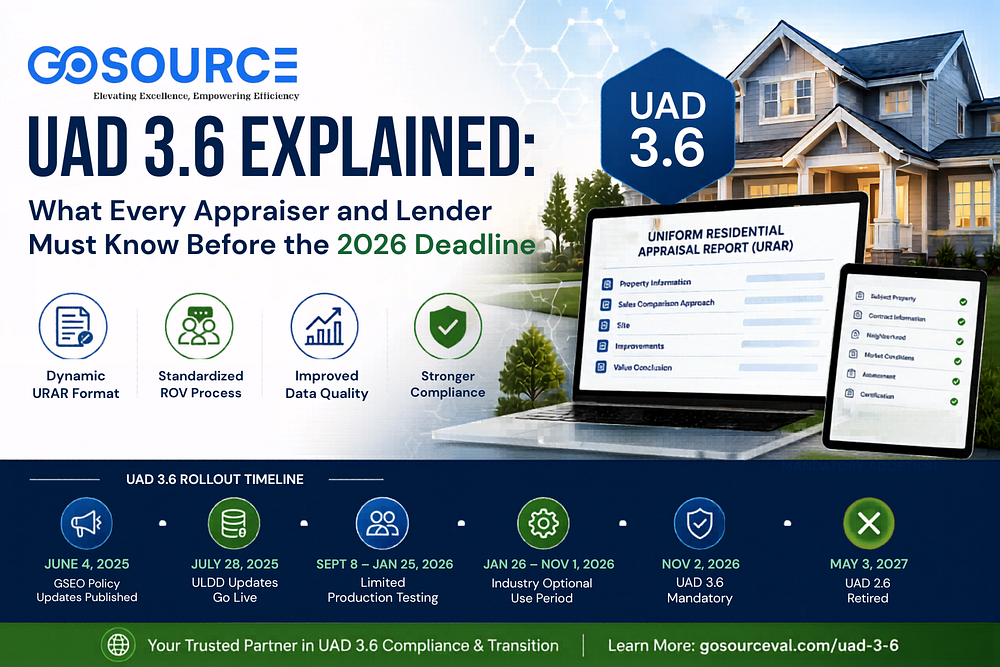
Why UAD 3.6 Matters More Than Any Previous Update
The Uniform Appraisal Dataset UAD has governed how residential property appraisal data is collected, standardized, and delivered to the GSEs, Fannie Mae, and Freddie Mac for over a decade. But the version most professionals have been working with, UAD 2.6, was built on a static, form-based model that was never designed to handle today’s complexity in property markets, regulatory expectations, or data science requirements.
UAD 3.6 changes entirely. This isn’t a routine update; it’s a structural redesign of how appraisal data flows through the mortgage ecosystem. For appraisers, AMCs, and lenders, adapting to UAD 3.6 is not optional. It’s a matter of license to operate in GSE-backed lending after November 2026.
Key Takeaway: UAD 3.6 replaces multiple legacy static appraisal forms with a single dynamic Uniform Residential Appraisal Report (URAR). Please complete the mandatory adoption by November 2, 2026. Legacy UAD 2.6 will be retired on May 3, 2027.
Read More: https://gosourceval.com/uad-3-6/
5 Critical Changes Introduced by UAD 3.6
Understanding the changes is the first step toward compliance. Here’s a structured breakdown of what’s different:
1. Single Dynamic URAR Format Replaces separate static forms 1004, 1073, 1025, etc. with one adaptable report that adjusts based on property type and appraisal scenario, reducing errors and inconsistencies across all report types.
2. Standardized Reconsideration of Value (ROV) A uniform ROV protocol aligned with federal fair lending regulations. Makes the reconsideration process transparent and auditable for lenders, borrowers, and regulators alike.
3. Expanded Scenario Coverage Appraisers gain broader options to describe unique property characteristics, unusual market conditions, and complex valuations.
scenarios, leading
4. Updated Quality and Condition Ratings Clarified definitions reduce subjective variation between appraisers, promoting fairer and more consistent property evaluations across all markets and property classes.
5. Revised Technical Documentation New guides, XML schemas, and API specs support the transition. Appraisal software platforms must update their systems to accept and deliver new data structures.
Official UAD 3.6 Rollout Timeline
Staying ahead of UAD 3.6 requires understanding each phase. Here is the complete timeline as established by Fannie Mae and Freddie Mac:
- June 4, 2025: GSE policy updates published; the formal start of the compliance clock
- July 28, 2025: ULDD Uniform Loan Delivery Dataset updates go into effect for loan delivery data
- September 8 and January 25, 2026: Limited production testing with select lenders, AMCs, and appraisal technology partners
- January 26, November 1, 2026: Industry-wide optional use period; all stakeholders are strongly encouraged to begin transitioning
- November 2, 2026: Full mandatory adoption; UAD 3.6 is required for all GSE appraisals from this date
- May 3, 2027: Legacy UAD 2.6 is officially retired; no submissions accepted under the old standard
- How AMCs Should Prepare for UAD 3.6
For appraisal management companies, UAD 3.6 represents both a challenge and an opportunity. AMCs that build robust compliance infrastructure now will be better positioned to attract lender clients and compete on quality in the years ahead.
Immediate Steps for AMC Compliance:
- Download and review the Lender Readiness Kit from Freddie Mac’s official resource portal
- Map legacy form types (1004, 1073, 1025) to the new dynamic URAR using GSE mapping guides
- Conduct internal training for review staff on updated quality and condition rating definitions
- Validate technical infrastructure: test XML schemas, API integrations, and data pipelines with UAD 3.6 sample files
- Update your ROV workflow to align with the standardized Reconsideration of Value process
- Communicate readiness timelines to lender clients early; this is a meaningful competitive differentiator
What Appraisers Need to Do Right Now
For individual certified appraisers and small firms, UAD 3.6 readiness is equally critical. The good news: You have time to prepare methodically if you start now.
Appraiser Readiness Checklist:
- Obtain and study the new dynamic URAR documentation from Fannie Mae’s official resource pages
- Enroll in GSE-sponsored or approved webinars and training sessions on the updated report structure
- Confirm your appraisal software vendor’s UAD 3.6 update timeline and compatibility roadmap
- Practice with sample URAR templates using the new quality and condition rating standards
- Update your engagement letters and scope of work templates to reflect UAD 3.6 requirements
- Connect with your AMC partners to align on submission standards and data field expectations
The Competitive Advantage of Early Adoption
History shows that in appraisal industry transitions, early movers gain disproportionate benefits. AMCs and appraisers who complete their UAD 3.6 transition during the optional use period, January through November 2026, will be able to accept more orders, reduce revision requests, and build credibility with lenders who are actively vetting compliance-ready partners.
Conversely, late adopters risk workflow disruptions, rejected submissions, and lender attrition at exactly the moment the mortgage market may be recovering. The cost of delay far outweighs the investment in early preparation.
Industry Insight: AMCs that integrate UAD 3.6 systems during the limited production phase, September 2025 — January 2026, will have a meaningful advantage in lender RFPs issued in Q1 2026. Read GoSource’s full UAD 3.6 breakdown at gosourceval.com/uad-3–6
Frequently Asked Questions About UAD 3.6
What is UAD 3.6? UAD 3.6, Uniform Appraisal Dataset 3.6, is a major modernization of residential appraisal reporting standards introduced by Fannie Mae and Freddie Mac. It replaces multiple static legacy forms with a single dynamic URAR format that adapts to different property types and appraisal scenarios.
When does UAD 3.6 become mandatory? UAD 3.6 becomes fully mandatory on November 2, 2026. Optional use begins January 26, 2026. Legacy UAD 2.6 is retired permanently on May 3, 2027.
How does the new dynamic URAR differ from existing forms? The dynamic URAR is a single adaptable report that replaces the 1004, 1073, 1025, and other static form types. It adjusts its fields and sections based on property type and scenario, reducing redundancy, improving data quality, and making appraisal reports more comparable across markets.
Does UAD 3.6 affect the Reconsideration of Value process? Yes. UAD 3.6 introduces a standardized ROV protocol aligned with federal fair lending regulations. This makes the reconsideration process more transparent and consistent for all parties’ lenders, borrowers, and appraisers.
What support is GoSource providing for UAD 3.6 transitions? GoSource Valuation has already integrated UAD 3.6 standards into its appraisal management systems. The team provides AMCs, lenders, and appraisers with technology-backed transition support, including data validation, review services, and operational consulting aligned with the new standards. Learn more at gosourceval.com/uad-3–6